On the afternoon of April 18, 2026, the 22nd Beijing International Sports Film Week Launch Event of Call for Entries & Opening Panel—“The Dual Olympic City and a New Chapter of the Winter Olympics” was held at T-Field, Langyuan Station, Beijing. Using visual storytelling as a medium, the event looked back at the glory of the dual Olympic city, explored the cultural transformation of the Winter Olympic legacy and innovative expressions in sports films and TV productions, and kicked off the call for entries for this edition of the Beijing International Sports Film Week (BISFW).
Xia Rihong, Deputy Secretary General of the Beijing Olympic City Development Association (BODA) and member of the Party Leadership Group and Deputy Director of the Beijing Olympic City Development Center, attended the event and delivered a speech. He noted that Beijing, as the world’s only dual Olympic city, boasts rich dual Olympic culture, providing abundant materials for sports films and TV productions. In the critical period of building China into a country strong in sports, sports films are an important vehicle for carrying forward the Olympic spirit and telling China’s sports stories well. Themed “The Dual Olympic City and a New Chapter of the Winter Olympics,” this panel hoped that creators could produce outstanding works with international influence that embody warmth and strength, with their focus on urban development and transformation, public fitness initiatives, and the core of sportsmanship.

Xia Rihong delivers a speech.
Wang Xiangrong, member of the Party Leadership Group and Deputy Curator of the China National Film Museum, attended the event. Panelists including Qi Guangpu, Olympic Champion and Grand Slam winner in freestyle skiing aerials and an ambassador for this edition of the BISFW; Li Tingwei, Deputy General Manager of Bauhinia Films; Wang Fangfang, a well-known director; Yu Jianhong, Vice President of the Beijing Film Academy; and Chang Lei, a retired curler and Executive Director of Hixi Media Group, engaged in in-depth exchanges on topics such as champion-focused narratives, cross-licensing, legacy transformation, and talent cultivation.

Qi Guangpu speaks at the panel.
Glory and film: seeing the real lives of athletes beyond gold medals
Qi Guangpu, a gold medalist on the Winter Olympic stage, shared his mindset in those critical moments on the slopes: calm before the start and focused solely on executing the moves honed over the years. He hoped that sports films could go beyond capturing the glory of victory, but more importantly, reveal the unseen daily lives of athletes: the recurring injuries, the agony of defeat, the longing for family, and the support from their teams and loved ones. Such vulnerability and perseverance behind the champions truly deserve to be seen.
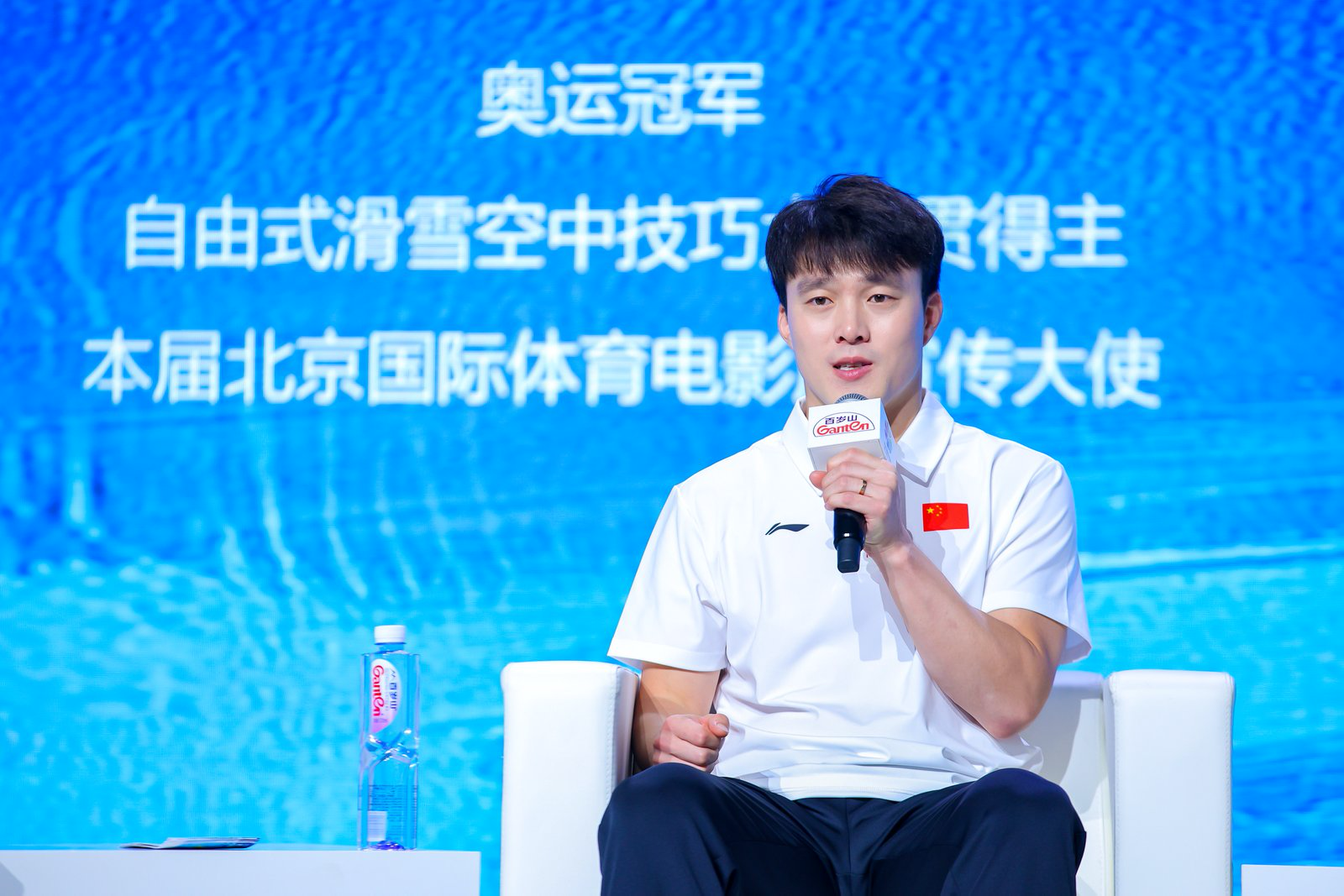
Qi Guangpu speaks at the panel.
\Wang Fangfang, director of well-received works such as Breaking Through and Champion, remarked that Olympic champions dedicate the prime of their lives to the arena. They are firm believers, profound thinkers about life, and carry the spirit of never resting on one’s laurels. He believes that the essence of a sports film lies in “verisimilitude,” that is, capturing the athletes’ ethos rather than merely replicating their on-field moves. Creation should be rooted in real-life experiences, balancing long-form life narratives with cinematic conflict, and employing sophisticated cinematography to break through the visual limitations of television broadcasting.

Wang Fangfang speaks at the panel.
Yu Jianhong, Vice President of the Beijing Film Academy, pointed out that current Winter Olympics themed films and TV productions have achieved significant breakthroughs: shifting its focus from trophy-driven highlights to the portrayal of personal growth, and from result-oriented narratives to process-oriented narratives. Creators now place greater emphasis on exploring athletes’ journeys of struggle and emotional depth, thereby connecting sportsmanship with everyday human experience.

Yu Jianhong speaks at the panel.
Cross-licensing: breaking boundaries to reach a wider audience
Chang Lei, who has transitioned from curling to the media industry, observed that winter sports had previously faced challenges such as low public awareness, high filming barriers, and difficulty in attracting sponsorship. However, after the Beijing 2022 Winter Olympics, public interest has significantly increased, bringing new opportunities for film and TV production. He proposed that the development of Winter Olympic intellectual properties should achieve emotional alignment, empathy, and resonance, telling relatable stories of imperfect life journeys and great comebacks that are accessible to the public and truly resonate, just like the comedy film Pegasus.

Chang Lei speaks at the panel.
From an industrial investment perspective, Li Tingwei remarked that the core intellectual property value of the dual Olympic city lies in “sportsmanship and a global vision.” A good sports film should achieve three levels of expression: authentic and vivid characters, multifaceted and profound humanity, and a humanistic spirit of faith and ideals, thereby carrying emotions, feelings, and deeper sentiments to connect with the times and the public. The commercial success of a sports film hinges on a sense of immersion and empathy. By integrating genres and multidimensional expression to counter the impact of short form content, sports films can break boundaries and deliver both social and economic benefits.

Li Tingwei speaks at the panel.
A new chapter: technology empowerment and talent support energize the sports film industry
Speaking of the demand for sports film and television talents after the Beijing 2022 Games, Yu Jianhong stated that the Beijing Film Academy upholds the principle of “solid foundations, emphasis on practice, and interdisciplinary approach” when promoting cross-disciplinary training between sports and filmmaking and deepening practice based teaching in collaboration with sports universities. New technologies such as AI and virtual production are leveraged to crack the code on capturing extreme winter sports, empowering student creators to produce sports works that are not only more authentic but also visually compelling.
The panelists agreed that sport embodies humanity’s quest to transcend limits and cinema is an art form that carries the emotions of an era, so the two are profoundly aligned. At a time when the global film industry is facing transformation and the impact of short-form content, sports films are seizing a unique opportunity for development with their uplifting narratives and authentic, inspiring stories. Future productions should be rooted in reality, dive into human nature, and explore innovative expressions, so that more audiences will enter cinemas and feel the power of sports and films.

A group photo of panelists.
This panel gathered industry consensus and charted a direction for carrying forward the dual Olympic culture and promoting the innovative development of sports film and TV productions. The call for entries for the 22nd BISFW is now open. Creators are warmly invited to engage in sports film and TV production, capturing the glory of sport with lenses and conveying the Olympic spirit. Together, let’s write a new chapter in building China into a country strong in sports and in culture.

© Copyright 2020. All rights reserved
Beijing Olympic City Development Association.All rights reserved.Beijing ICP 11016671 No.
